We frequently see project managers lose sleep over tender deadlines, scrambling to organize hundreds of technical documents third-party laboratory test reports 1. In our daily operations supporting municipal bids, we notice that simply having a good product is not enough; the paperwork must tell the correct story without any ambiguity. If the datasheet is messy, the evaluator assumes the product is too.
To prepare LED datasheets for direct tender use, you must map every technical parameter in the tender specification directly to your product’s data, ensuring zero deviations. This involves compiling third-party laboratory test reports (LM-79, LM-80, IP ratings) that substantiate every claim on the sheet, formatting the document to match the tender’s required Annexure or template, and removing any conflicting marketing text that doesn’t serve a technical purpose.
Here is how you can transform a standard factory spec sheet into a winning tender document.
How can I ensure my LED datasheets meet all technical compliance requirements for a municipal tender?
When we analyze tender documents from regions like the Balkans or Central Asia, we often spot specific “trap” clauses designed to filter out careless bidders LM-79 2. If our engineering team misses a single line item regarding power factor or impact protection, the entire bid could be rejected regardless of price.
You ensure compliance by creating a line-by-line Compliance Matrix that compares the tender’s technical specifications against your datasheet values and the supporting test standards. This process requires you to explicitly state “Complied” for every parameter, cite the specific international standard (such as IEC 60598 or LM-80) that validates the claim, and customize the datasheet to highlight these specific metrics rather than generic marketing features.
To truly guarantee that your LED datasheets meet compliance requirements, you must move beyond the standard “marketing” datasheet Clasificaciones IP 3. Marketing sheets are designed to sell features; tender datasheets are designed to prove facts. The most effective strategy we use is the “Mirror Method.” You must mirror the structure of the tender’s technical requirements IEC 60598 4. If the tender lists “Luminous Efficacy” as Item 3.1, your datasheet should ideally list it in a prominent position, clearly visible to the evaluator Declaration of Conformity certificates 5.
Municipal tenders often follow a binary logic: Pass or Fail. There is rarely a middle ground for “suficientemente cerca.” Therefore, your preparation must focus on evidence-based compliance total luminous flux 6. Every number written on the datasheet must be traceable to a laboratory report. For instance, if you claim a 100,000-hour lifespan, you cannot simply write “100,000 hours.” You must reference the TM-21 calculation 7 based on LM-80 8 data.
The Role of the Compliance Matrix
Before you finalize the datasheet, you should draft an internal Compliance Matrix 9. This simple tool acts as a filter to catch errors before the evaluation committee does.
| Tender Requirement Item | Required Value | Datasheet Value | Status | Reference Standard |
|---|---|---|---|---|
| Eficacia del sistema | ≥ 140 lm/W | 145 lm/W | Complied | IEC 62722-2-1 |
| Color Rendering Index | IRC > 70 | CRI 75 | Complied | CIE 13.3 |
| Ingress Protection | IP66 | IP66 | Complied | IEC 60529 |
| Impact Resistance | IK08 | IK09 | Complied | IEC 62262 |
| Protección contra sobretensiones | 10kV | 10kV / 20kV | Complied | IEC 61000-4-5 |
Handling “Zero Deviation” Clauses
Many public tenders strictly enforce “Zero Deviation.” This means if the tender asks for “Die-cast aluminum housing with <0.1% copper content,” and your datasheet just says “Aluminio,” you might be disqualified. You need to be specific. We often modify our standard datasheets for our partners to include the exact phrasing found in the tender, provided it is true. This psychological mirroring reassures the evaluator that they are looking at the exact product they asked for. If a parameter deviates even slightly—for example, the tender asks for 120W but the closest standard driver output is 122W—you must clarify this in a separate “Deviation Statement” or adjust the drive current to match exactly, if the technology permits.
What specific documentation should I request from a supplier to avoid disqualification during the evaluation phase?
Our export department spends hours every week compiling “Technical submission packs” because we know that a single missing certificate is the easiest reason for a bureaucrat to reject a bid. We have learned that proactive over-documentation is safer than waiting for a clarification request that might never come.
To avoid disqualification, you must request a complete “Technical Verification Pack” that includes the signed and stamped technical datasheet, valid third-party accredited test reports (LM-79 for photometry, LM-80 for LED chip lifespan, ISTMT for thermal management), and current Declaration of Conformity certificates (CE, RoHS, ENEC). Additionally, you need an authorized Manufacturer’s Authorization Form (MAF) explicitly naming your company as the bidder for that specific project.

The evaluation phase of a tender is a forensic audit. The evaluators are looking for inconsistencies. If your datasheet claims a Power Factor of 0.98, but the test report attached shows 0.93, you will be flagged. Therefore, the documentation you request from your supplier must be a coherent, non-contradictory set.
El “Holy Trinity” of Tender Documents
There are three pillars of documentation that must align perfectly. If any of these contradict the others, your risk of disqualification skyrockets.
- The Datasheet: This is the manufacturer’s promise. It summarizes performance.
- The Test Report: This is the proof. It must come from an accredited lab (ILAC/CNAS).
- The Certificate: This is the legal license. It proves safety and regulatory compliance.
You cannot rely on a supplier who sends you a “sample report” from three years ago. You need reports that match the exact model number you are bidding. If the model number on the datasheet is “CST-SL-100W” and the test report says “CST-SL-Series,” you might face questions. It is better to ask the supplier to update the report cover or issue a “Declaración de Identidad” confirming that the tested model covers the specific item in the bid.
Essential Document Checklist
We recommend using this checklist when communicating with your factory partner. Do not assume they will send these automatically; retail suppliers rarely understand these requirements.
| Nombre del documento | Objetivo | Critical Verification Point |
|---|---|---|
| LM-79-08 Report | Verifies total flux, efficacy, and distribution. | Ensure “Test Date” is recent and voltage matches local grid (e.g., 230V). |
| LM-80-15 & TM-21 | Proves LED chip longevity (L70/B10). | Check that the drive current in the report matches your fixture’s driver current. |
| IP & IK Reports | Validates environmental protection. | Must be for the complete luminaire, not just the housing. |
| IEC/EN Certificates | Safety compliance (LVD/EMC). | Verify the certificate is still valid and issued by a recognized body (TUV, SGS, etc.). |
| ISO 9001/14001 | Manufacturer’s quality management. | Must be current and cover the manufacturing scope of LED lighting. |
Furthermore, do not overlook the Manufacturer Authorization Form (MAF). In many strict tenders, if the factory does not explicitly authorize you to bid, your datasheets are considered invalid, no matter how good they are.
How do I verify that the IES files and photometric data align perfectly with the tender specifications?
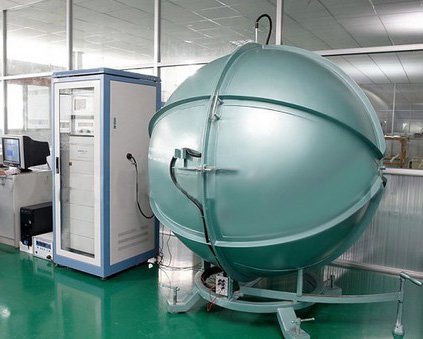
In our photometric laboratory, we run goniophotometer tests daily, and we know exactly how easy it is to manipulate software to generate “perfect” but fake data. We constantly advise our partners to look deeper than just the summary page to ensure the light simulation results will hold up to scrutiny.
You verify alignment by opening the IES file in photometric software (like Dialux or Relux) to check that the total luminous flux and power consumption match the datasheet exactly, and by inspecting the candela distribution curve to ensure it meets the required beam angle type (e.g., Type II or Type III). You must also cross-check the .IES file header information to confirm it was generated from a real laboratory measurement rather than a purely theoretical simulation.
Photometric data is the heart of any lighting tender. The tender usually specifies a required “Lighting Class” (e.g., M3 or ME4a for roads), which dictates average lux, uniformity, and glare control. These calculations depend entirely on the accuracy of the IES file. If the IES file does not perfectly align with the datasheet, your lighting design calculation is invalid.
Analyzing the IES File Structure
When you receive an IES file, do not just load it into Dialux. Open it with a text editor (Notepad). Look at the header information. A legitimate test report usually includes the testing laboratory’s name, the goniophotometer model (e.g., “Everfine GO-2000”), and the date. If these fields are empty or generic, it might be a generated file.
Common Photometric Discrepancies
We often see discrepancies where the datasheet claims the “Source Flux” (raw LED output) while the IES file correctly shows the “Luminaire Flux” (output after lens and cover losses). Tenders almost always require Luminaire Flux. If your datasheet says 15,000 lumens (Source) but your IES file shows 13,500 lumens (Fixture), and the tender asks for 14,000 lumens, you will fail.
| Parámetro | What to Verify | Warning Sign |
|---|---|---|
| Flujo luminoso total | Must match the datasheet ±5% tolerance. | IES flux is significantly higher than datasheet (suspicious). |
| Input Wattage | Must match the rated power of the fixture. | Wattage in IES file is “1W” o “0W” (incomplete data). |
| Luminous Dimensions | Width/Length of the light emitting area. | Dimensions listed as 0mm x 0mm x 0mm (bad simulation). |
| Asymmetry | Street lights usually require asymmetrical throw. | The light distribution looks like a perfect circle (wrong beam angle). |
The Consequence of Mismatch
If you submit a lighting calculation report claiming you achieved the required lux levels, but the evaluator notices your IES file lists 140W while your datasheet lists 150W, they will question the validity of the entire calculation. Consistency is key. You must ensure that the specific “Binning” of LEDs used in production matches the file you submit. If we upgrade our LED chips to a newer generation, we immediately re-test and issue new IES files. You should demand the same rigor.
Can my Chinese supplier provide submission-ready technical sheets that don’t require further editing?
Working closely with partners in Kazakhstan and Armenia, we have realized that the definition of “ready” varies wildly between a standard wholesale factory and a project-focused manufacturer. A standard factory expects you to do the work; a true partner understands that their job is to make your bid winnable.
Yes, your Chinese supplier can provide submission-ready datasheets, but only if they specialize in project business (OEM/ODM) rather than retail distribution and understand the specific format of tender compliance documents. You should look for suppliers who offer “White Label” services, provide editable source files (Word/Indesign), and have a dedicated engineering team capable of customizing parameters and adding your logo and model numbers directly onto the technical sheets.

The reality of the supply chain is that 90% of lighting factories in China are volume-driven. They sell standard products with standard catalogs. If you ask them for a “Tender Spec Sheet,” they will likely send you their standard PDF catalog, which might include Chinese text, irrelevant features, or contact details that bypass you. This is useless for a tender.
Factory vs. Project Partner
A “Project Partner” operates differently. When we receive a request, we do not just send a catalog. We ask for the tender requirements first. Then, we generate a specific datasheet for that project. This document will feature your model number, your logo (if requested), and only the technical data relevant to the bid. This saves you hours of Photoshop work and reduces the risk of copy-paste errors.
Communication Protocols for Success
To get submission-ready docs, you must drive the process. Do not ask “Can you send me the spec?” Instead, ask: “Can you fill out this technical data schedule?” o “Can you provide the datasheet in an editable Word format?”
| Característica | Retail/Wholesale Supplier | Project/Tender Specialist |
|---|---|---|
| Datasheet Format | Locked PDF with factory branding. | Editable Word/PDF or White Label. |
| Parameter Flexibility | “Take it or leave it” (Standard specs). | Customizable driver currents/CCT to match tender. |
| Response to Deviations | Ignores them or says “Standard is better”. | Provides specific technical arguments or modifies product. |
| Support Documents | Generic CE certificates. | Project-specific authorizations and full test reports. |
El “White Label” Estrategia
For high-stakes tenders, we often recommend the White Label strategy. We provide the technical content, but the document is branded entirely as yours. This protects your source (us) and presents you as a manufacturer or the prime authorized agent. However, this requires trust. You must verify that the supplier is willing to stand behind the product with a warranty letter in your name. If a supplier refuses to remove their own logo from a datasheet, they are likely more interested in brand exposure than helping you win the project.
Conclusión
Preparing LED datasheets for tenders is not an administrative task; it is a strategic one. The documentation is the bridge between the physical product and the evaluator’s approval. By ensuring zero-deviation compliance, securing a complete and consistent “Holy Trinity” of documents (Datasheet, Test Reports, Certificates), verifying photometric integrity, and partnering with a supplier who understands the project ecosystem, you transform a risky bid into a secure contract. Success lies in the details—matching every lumen, watt, and certification to the letter of the tender.
Notas a pie de página
1. Explains the importance of independent verification for product claims. ↩︎
2. Defines a key photometric test standard for LED products. ↩︎
3. Clarifies the standard for ingress protection of enclosures. ↩︎
4. Replaced with a working link from BSI, a national standards body, providing an overview of the IEC 60598 standard. ↩︎
5. Replaced with a working link from ‘Your Europe’, an official website of the European Union, providing authoritative information on the EU Declaration of Conformity. ↩︎
6. Replaced with a working link to Wikipedia, which provides a comprehensive and authoritative definition of total luminous flux. ↩︎
7. Describes the method for projecting LED lumen maintenance. ↩︎
8. Explains the standard for measuring LED lumen maintenance. ↩︎
9. Explains a tool used to compare tender specifications with product data. ↩︎