
Straße & Infrastrukturbeleuchtung
Road Lighting Solutions for Infrastructure Projects
Road lighting supply for contractors, project suppliers and infrastructure procurement teams, with luminaire options and technical documentation matched to project requirements.
Road lighting is not chosen by wattage. It is worked out from the road, the lighting class, the pole layout and the surroundings. This guide shows which project data drives each decision.
Projektanträge
Road Lighting Applications We Supply
Different roads need different luminaire specifications. Mounting height, light distribution, colour temperature and controls all change with the road type. Here is what usually matters for each, and what to send us so we can match products.
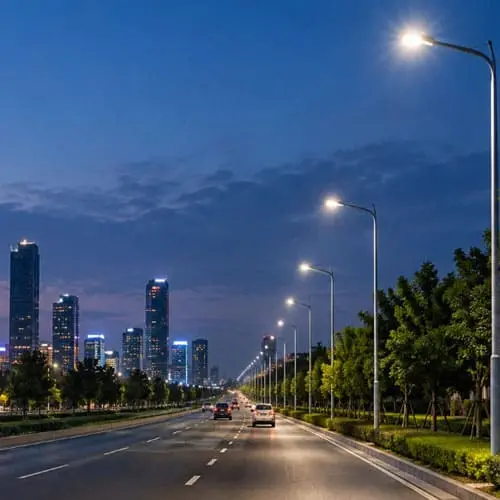
Urban Roads and Collectors
Mixed traffic and nearby buildings make glare control and consistent light levels important. Typical points to specify: lighting class, pole height and spacing, and light distribution such as Type II or III.
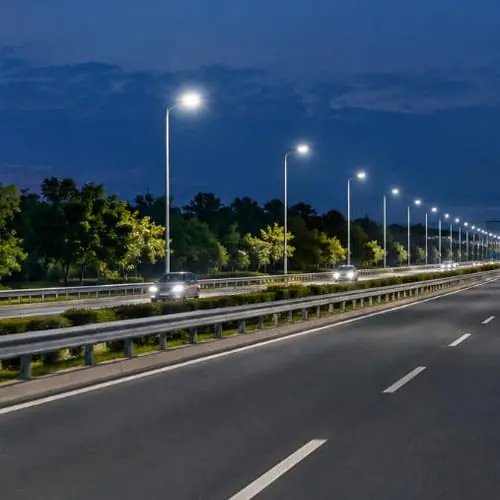
Autobahnen & Hauptstraßen
Higher speeds usually mean taller poles and wider spacing, so uniformity and maintenance access matter. Typical points to specify: mounting height, light distribution and control socket.
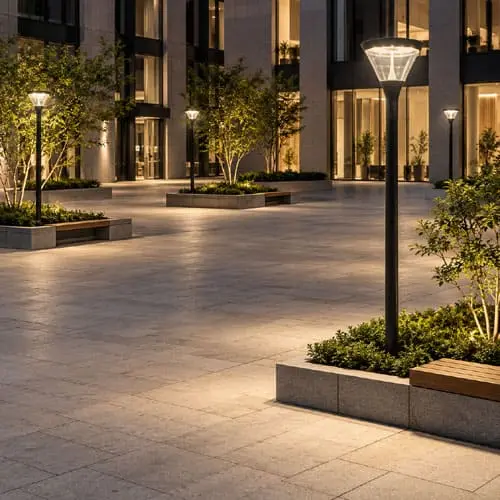
Residential Streets
Light must reach the road without spilling into homes. Warmer colour temperatures and tight glare control are common requirements, often with a Type II distribution.
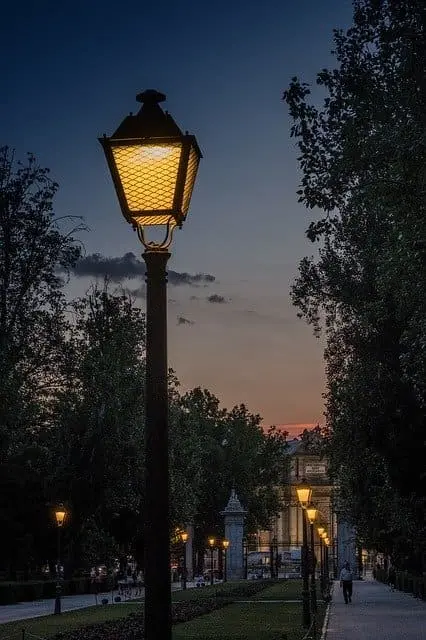
Road Intersections
Conflict areas are normally lit to a higher level than the road around them. Specify the conflict-area class, and a circular or wide-throw distribution where the designer calls for it.
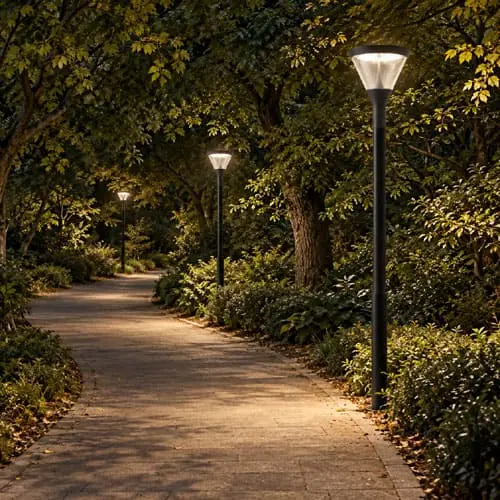
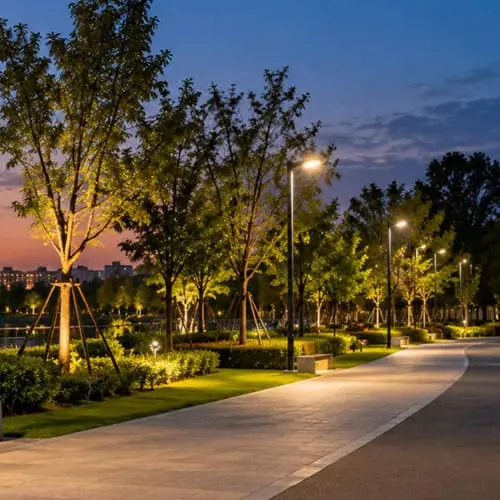
Walkways & Bike Paths
Lower mounting heights and pedestrian focused criteria apply. Check the impact rating and glare at eye level.
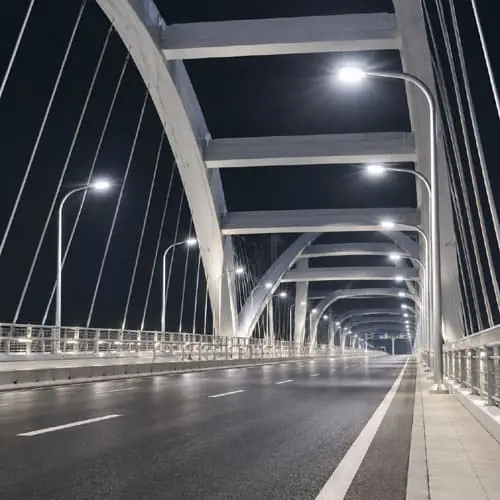
Bridges & Access Roads
Pole loading and structural mounting limit the choice of luminaire. See our bridge lighting page for structure related points.
Produktauswahl
LED Lighting Products for Road Projects
Most road lighting projects use LED street lights. Other fixtures cover paths and junctions.
ROADWAY
Roadway luminaires for highways, urban roads and residential streets. Optics, wattage and mounting matched to the project specification.
PATHS & STREETS
Lower mounted lights for pedestrian paths, cycle routes and residential streets. Useful where glare at eye level matters.
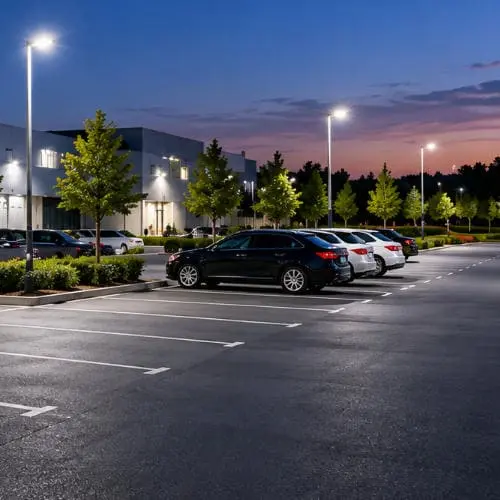
OPEN AREAS
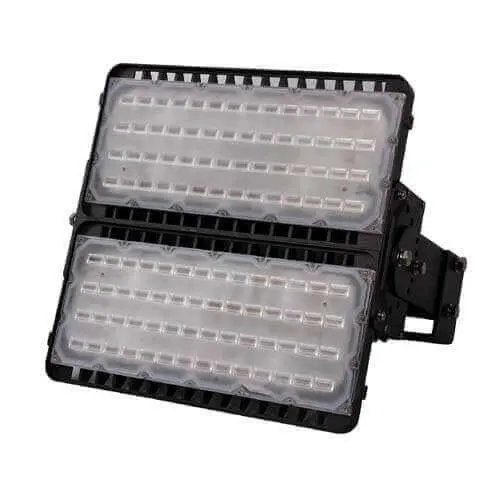
Wide beam lighting for large junctions, interchanges and open areas. Aiming and glare control reviewed per site.
Choose Road Lighting by Road Type and Purpose
| Road Area | Lighting Purpose | Typical Fixtures |
|---|---|---|
| Main roads | ||
| Highways and arterial roads | Visibility at higher speeds, even light along long runs | LED-Straßenlaternen |
| Urban and collector roads | Consistent light for mixed traffic, glare control near buildings | LED-Straßenlaternen |
| Residential streets | Safe visibility with limited spill light into homes | LED street lights, post-top lights |
| Special areas | ||
| Junctions and roundabouts | Higher light level in conflict areas | LED street lights, LED flood lights |
| Pedestrian and cycle paths | Low mounting, glare control at eye level | Post-top and garden lights |
| Rural and access roads | Basic visibility where traffic is light | LED-Straßenlaternen |
| Bridge approaches | Transition from road to structure | LED street lights. See bridge lighting. |
Auswahlhilfe
What to Check When Selecting Road Lighting
Confirm these points before choosing luminaires. They narrow the options and avoid selecting by wattage alone.
Road Type & Beleuchtungsklasse
Road type and speed. Lighting class or standard in the tender. Local authority requirements.
Pole Layout & Montage
Pole height and spacing. Single-sided, staggered, opposite or median. Bracket outreach and tilt.
Lichtverteilung & Blendung
Type II, III or V pattern. IES/LDT files. Glare, spill light and colour temperature.
Power, Control & Sockets
Supply voltage. Driver and dimming interface. 3‑pin, 5‑pin or 7‑pin socket. Photocell and surge protection.
Enclosure & Umfeld
IP and IK ratings. Corrosion resistance for coastal sites. Temperature, dust and vibration.
Access & Dokumentation
Pole height and access. Replacement and spare parts. Datasheets, certificates and test reports.
Which Lighting Product Is Suitable for Your Road Project?
| Produkt | Typical Application | Key Selection Factors |
|---|---|---|
| LED-Straßenlaternen | Highways, urban roads, residential streets, junctions | Lighting class, pole height and spacing, light distribution, control socket, IP and IK rating |
| LED Post-Top & Gartenleuchten | Pedestrian paths, cycle routes, residential streets | Mounting height, glare control, colour temperature, impact rating |
| LED-Flutlichter | Large junctions, interchanges, open areas | Lumen output, beam angle, aiming position, glare control |
Not Sure Which Road Lighting Fits Your Project?
Send your tender specification, pole data or product schedule. We will review the requirements and suggest products for evaluation. Lighting class and calculations stay with your designer.
Standards & Beleuchtungsklasse
Match the Road to a Lighting Class
The lighting class sets the target: how bright the road surface should be, how evenly, and how much glare is tolerated. It is normally set by the road authority or the project designer from the road type, speed, traffic volume and conflict risk.
EN 13201
M classes for roads with motorised traffic, C classes for conflict areas such as intersections, and P classes for pedestrian and cycle areas.
AS/NZS 1158
V categories for roads with vehicle traffic and P categories for pedestrian areas and public spaces.
ANSI/IES RP-8-25
Recommended practices and lighting criteria for roadways, streets, intersections and parking facilities.
- Always check the standard edition and lighting class specified in the tender documents. Requirements may vary by country, local authority and project. Product certificates and test documents are model and market specific, so confirm availability for the selected products.
Layout Considerations
Pole Layout and Mounting Conditions
Four arrangements cover most road lighting projects. The right one depends mainly on how wide the road is compared with the mounting height.
| Layout | Typically Suits | Considerations |
|---|---|---|
| Single-sided | Narrow roads, where the width is modest compared with the mounting height | Fewest poles. Light reaches the far side at a shallower angle, so uniformity depends on the optic. |
| Opposite | Wide carriageways that need even coverage on both sides | Most poles and highest cost, with consistent coverage at both kerbs. |
| Staggered | Medium-to-wide roads where both sides need light | Fewer poles than opposite. Spacing must be calculated carefully, or dark gaps appear. |
| Central median | Dual carriageways with a central reservation | Lights both carriageways from one pole line. Needs enough median width and pole impact safety checks. |
Mounting height, arm length and spacing work together. Raising the pole can widen coverage but changes glare and spill light. Increasing spacing cuts the pole count but raises the risk of dark gaps between poles.
The right combination must be verified through a photometric calculation based on the actual road geometry. This calculation should be completed by your lighting designer or engineer; CST can provide available product photometric files for the selected model.
Kontrollen & Schutz
Control Sockets
Many street light specifications ask for a NEMA twist-lock socket on top of the luminaire. The pin count decides what the socket can carry. Many standards also allow a lower class when night traffic is light, so dimming can cut energy use if your specification permits it.
On/off switching
3 power contacts (ANSI C136.10). Switches the luminaire on and off, for example with a photocell. It carries no dimming signal.
Adds a dimming signal
3 power and 2 signal contacts (ANSI C136.41). The signal contacts can carry a dimming signal such as 0-10V or DALI.
More control contacts
3 power and 4 signal contacts (ANSI C136.41). More signal contacts for dimming and other control functions.
Specify the NEMA socket clearly, such as 3-pin NEMA or 7-pin NEMA, rather than using an unclear description. Match the pin count to the photocell or control node required for the project, and state whether a photocell or a shorting cap should be supplied. Also specify the required surge protection, IP rating and IK impact rating in the enquiry.
Technische Unterstützung
Technical Information for Product Evaluation
We provide available product information to support evaluation, tender preparation and procurement review. The exact document set depends on the selected model and project requirements.
| Document | Zweck | Availability |
|---|---|---|
| Product datasheet | Electrical data, dimensions, materials and product specifications | Available for selected products |
| IES / LDT photometric files | Photometric input for the project’s lighting design and calculation | Available for most models; confirm exact model |
| Product drawings | Dimensions, mounting interface and installation reference | Subject to product model |
| Certificates and test reports | Support product compliance and project approval | Confirm by model and destination market |
| Packaging and supply information | Procurement, shipping and project delivery planning | Provided during quotation and order review |
Retrofit Projects
Retrofit Projects: Check Before You Replace
Replacing old lamps with LEDs is a new road lighting design, not a like-for-like replacement. Check these five points before selecting products.
Recalculate
LED distribution different from sodium and metal halide, so the designer need recalculates.
Recheck the lighting class
Confirm the old layout still meets the class required today.
Measure on site
Real pole height, arm length, spacing and tilt.
Check arms and brackets
Confirm they suit the new luminaire.
Verify pole condition
Reuse poles only after a qualified engineer confirms their condition.
Retrofit calculations and pole checks stay with your designer and engineer. Send us the existing pole and arm details, and we will tell you which luminaires suit them.
Project Supply Process
How We Support Your Road Lighting Order
We supply LED street lights built in our factory. Design, pole planning and installation stay with your designer and contractor. Our role is to match the right products to your confirmed specification and deliver them.
Share Project Requirements
Send the road type, specification, quantity, destination and required documents.
Review Product Options
We review suitable product options, configurations and available technical information.
Confirm Technical Documents
Check datasheets, IES/LDT availability and compliance documents for the selected model.
Quotation & Sample Review
Confirm price, samples where required, order quantity and commercial terms.
Produktion & Quality Follow-up
Coordinate production progress and the agreed inspection and documentation requirements.
Verpackung & Shipment
Confirm packing details, shipping arrangements and export documents for delivery.
Project Experience
Roadway Lighting We Have Supplied
Lighting products supplied for road and infrastructure applications.
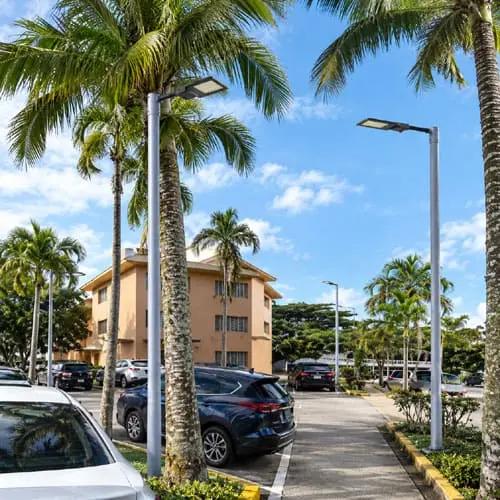
Costa Rica · Road & Außenbeleuchtung
Street Light in Costa Rica
150W street light supplied for outdoor roads and public areas, supporting the project’s lighting and installation requirements.
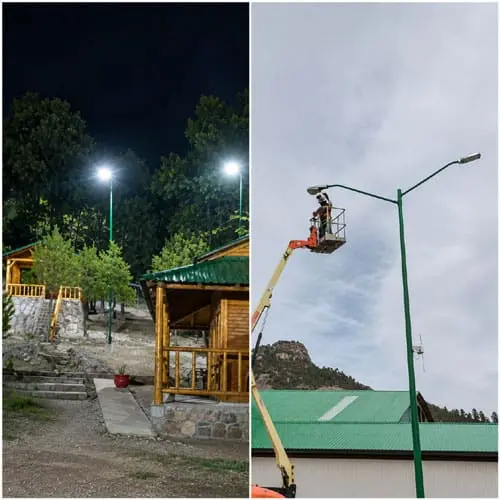
Mexico · Road & Infrastruktur
Street Light in Mexico
50 and 200W street light supplied for outdoor rural road lighting project, installation on existing light poles.
Dominican · Park Lighting
Parks & pedestrian Lighting in DO
100W conical LED park light for park and pedestrian lighting.
FAQs
Road Lighting Project FAQs
You usually don’t choose it alone. The road authority or project designer sets the class from the road type, speed, traffic volume and conflict risk, under the standard named in the specification, such as EN 13201, AS/NZS 1158 or IES RP-8. If the class is not stated, ask your designer or the road authority. We supply the luminaires and do not set the class.
No. LEDs distribute light different from high pressure sodium lamps, and the old layout may not meet today’s class. Wattage should come out of a calculation by your designer that uses the class, pole height, spacing, optic and maintenance factor. A one-to-one replacement by wattage can leave dark gaps or waste energy.
Spacing and mounting height decide how evenly light covers the road. Wider spacing means fewer poles but a higher risk of dark gaps. Tighter spacing improves uniformity but adds cost. The best balance depends on the optic and the class, so it is confirmed by calculation rather than by experience.
Warmer tones are commonly chosen for residential streets and environmentally sensitive areas because they help limit light pollution. Neutral white is common on main roads. Your project specification or local rules take priority. Keep the colour temperature consistent along one road so drivers do not meet sudden changes.
Type II and Type III are IES light distribution patterns. Type II suits narrower roads with the pole at the side, and Type III throws light farther across wider roads. The 3-pin and 5-pin terms describe the twist-lock control socket. A 3-pin socket switches the luminaire on and off, and a 5-pin socket also carries a dimming signal. Your designer or tender documents should state both, because they change which luminaire can be used.
Sometimes. Three things decide it: the pole’s condition, the arm and bracket interface, and whether the existing height and spacing still reach the required lighting class with the new optic. A qualified engineer should confirm the pole’s condition and structural suitability, and your designer should confirm the lighting class. Send us the arm and bracket details, and we will check them against the luminaire’s mounting interface.
Verwandte Produkte
Explore Other Lighting Products
View product categories that may be relevant to your lighting requirements.
Tell Us About Your Road Lighting Project
Share your drawings, project photos or product requirements. Our team will review the information and get back to you with suitable product options and quotation details.
Haben Sie weitere Details? Schicken Sie es per E-Mail an sales@ledcst.com.